
The 10 Biggest Daily Frustrations of Living with ADHD
That Most People Never See

If you’ve ever looked at your to-do list, fully understood what needed to be done, genuinely wanted to do it, and then somehow ended up deep-cleaning the junk drawer instead... welcome to the wonderfully baffling world of ADHD.
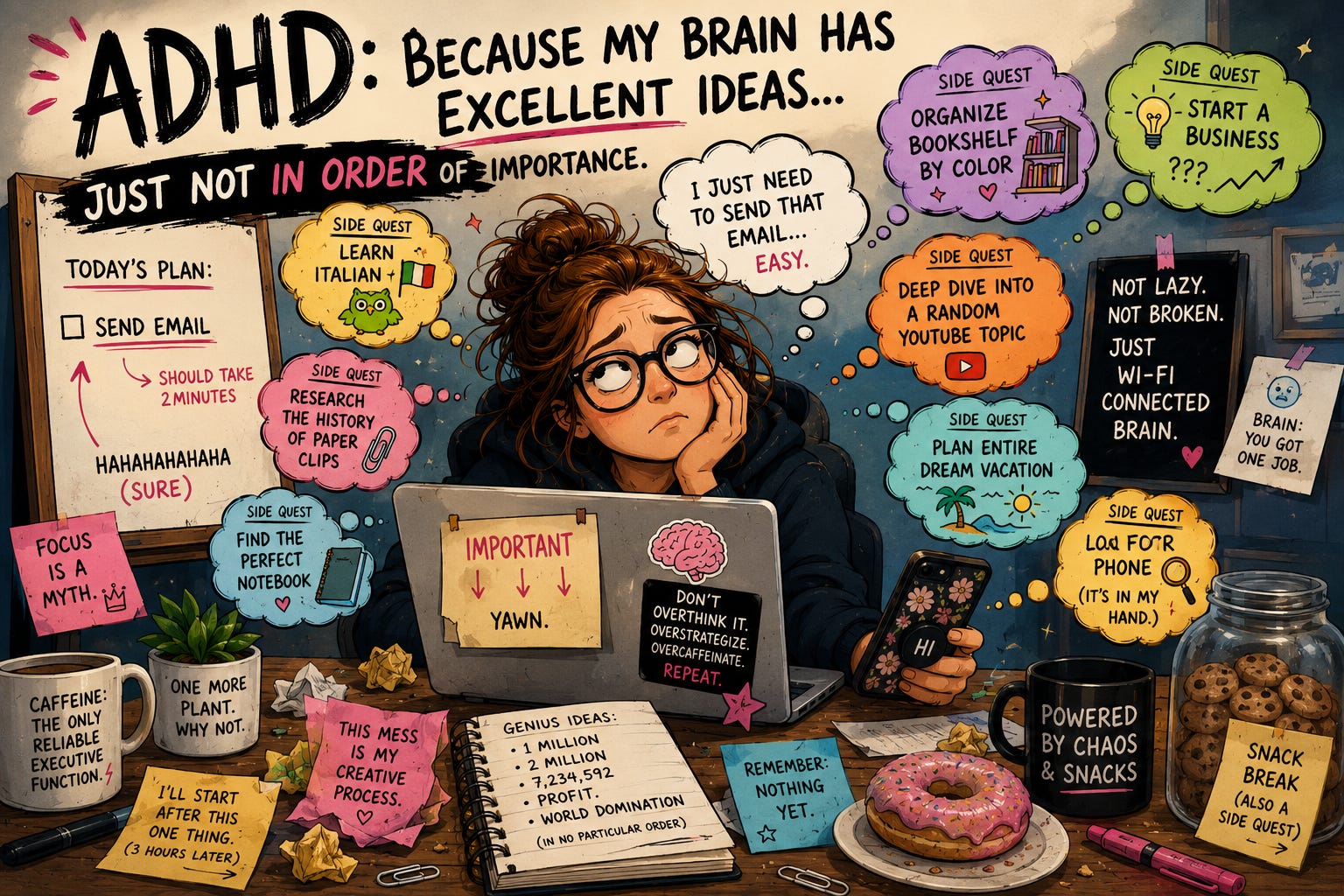
ADHD isn’t just about being distracted or forgetful. It’s a complex neurological condition that affects executive functioning—the mental processes that help us plan, prioritize, initiate tasks, manage time, regulate emotions, and follow through.
The frustrating part? Most people with ADHD know exactly what they need to do.
Doing it is where things get complicated.
Here are some of the biggest daily frustrations people with ADHD face.
1. Knowing What to Do but Not Being Able to Start
One of the most misunderstood ADHD struggles is task initiation.
Imagine needing to send an email. It’s a simple email. It will take three minutes. You know what to write.
Yet somehow your brain treats it like you’ve been asked to defuse a bomb underwater while translating ancient Greek.
From the outside, it looks like procrastination.
From the inside, it feels like being trapped behind an invisible wall.
This disconnect often leaves people with ADHD feeling confused, frustrated, and questioning themselves.
2. Living in a Constant Cycle of Procrastination
ADHD procrastination isn’t usually about laziness.
Often, the brain struggles to engage with tasks that are boring, overwhelming, repetitive, or lacking immediate rewards.
The cycle tends to look something like this:
Avoid the task
Feel guilty about avoiding the task
Stress about the task
Panic because the deadline is now terrifyingly close
Complete the task in a burst of adrenaline-fueled productivity
Feel exhausted
Repeat forever
It’s not exactly the productivity method most life coaches would recommend.
3. Forgetting Things That Actually Matter
People with ADHD don’t just forget random details.
They forget things they genuinely care about:
Important meetings
Friends’ birthdays
Returning messages
Paying bills
Following up on commitments
That thing they were literally thinking about thirty seconds ago
The frustration comes from knowing that forgetting doesn’t reflect how much they care.
Unfortunately, it can sometimes look that way to others.
4. Time Blindness Is Real
Many people with ADHD struggle to accurately perceive time.
A quick task suddenly takes an hour.
An hour somehow disappears in what feels like ten minutes.
A deadline that seemed comfortably far away yesterday is somehow due today.
This phenomenon, often called “time blindness,” can make scheduling, planning, and punctuality incredibly difficult.
It’s not a lack of respect for other people’s time.
It’s often genuinely difficult to sense the passage of time.
5. Being Told to “Just Try Harder.”
If there were an ADHD Hall of Fame for unhelpful advice, “just try harder” would be a first-ballot inductee.
People with ADHD often hear things like:
“You need more discipline.”
“Just focus.”
“Get organized.”
“Everyone struggles with that.”
The reality is that many people with ADHD have spent years trying harder than anyone realizes.
The issue isn’t effort.
It’s that the brain’s systems for attention, motivation, and executive function don’t always respond to effort alone.
6. Never Knowing Which Version of Yourself Is Showing Up
One of the most confusing aspects of ADHD is inconsistency.
One day you can:
Solve complex problems
Manage multiple projects
Respond to every email
Feel unstoppable
The next day you stare at a simple task for twenty minutes and somehow accomplish absolutely nothing.
This inconsistency can be incredibly discouraging.
People often wonder:
“If I did it yesterday, why can’t I do it today?”
The answer usually isn’t a lack of ability.
It’s the unpredictable nature of ADHD attention and motivation systems.
7. Emotional Reactions That Feel Bigger Than Expected
ADHD doesn’t just affect attention.
It often affects emotional regulation too.
Many people experience:
Intense frustration
Sensitivity to criticism
Difficulty recovering from setbacks
Strong emotional reactions to perceived rejection
What may seem like a minor comment to someone else can feel deeply personal and difficult to shake.
Managing these emotional responses can be just as exhausting as managing attention.
8. The Mental Clutter Never Stops
Many adults with ADHD describe their minds as having dozens of tabs open simultaneously.
Some are important.
Some are random.
A few are playing music.
One is frozen.
And none of them seem willing to close.
This constant mental traffic can make it difficult to:
Prioritize
Focus
Make decisions
Remember information
Relax
The result is often mental exhaustion long before the day is over.
9. Everyday Tasks Feel Like They Regenerate Overnight
Laundry.
Dishes.
Emails.
Paperwork.
Cleaning.
Grocery shopping.
Most people don’t love these tasks, but for many people with ADHD, routine maintenance feels particularly overwhelming.
You finally finish one task only to discover three more have spawned in its place.
Household management can start to feel like playing a video game with no final level.
10. The Weight of Shame
Perhaps the hardest frustration isn’t the symptoms themselves.
It’s the stories people start telling themselves because of those symptoms.
After years of hearing:
“You’re so smart, but...”
“You have so much potential...”
“Why can’t you just apply yourself?”
Many people begin to internalize the idea that they’re lazy, unreliable, careless, or failing.
In reality, they’re often working incredibly hard just to manage tasks that others take for granted.
The Frustration Behind All the Frustrations
At its core, ADHD often feels like this:
“I know what needs to happen. I want it to happen. I just can’t reliably make my brain cooperate.”
That gap between intention and action is where so much of the daily frustration lives.
The good news is that understanding ADHD changes everything.
When people stop viewing these struggles as personal flaws and start recognizing them as neurological challenges, they can build strategies, systems, and support that actually work with their brains instead of against them.
And perhaps most importantly, they can stop blaming themselves for difficulties that were never about laziness in the first place.
Because ADHD isn’t a character flaw.
It’s a different operating system—and like any operating system, it works best when you learn how it’s designed.
Accelerated, Dynamic, Hyper-Drive: A Short Manifesto for ADHD Entrepreneurs Who Refuse to Play Small.
This isn’t another productivity book written by someone whose greatest risk was color-coding spreadsheets. It’s for ADHD entrepreneurs, creators, and visionaries who are tired of shrinking themselves to fit systems built for smaller thinking.
Because your ADHD is not proof you’re incapable.
It may be proof you were built for something bigger.
Download your copy here:
Before your inner critic talks you into playing small for another year.