
Productivity Tools are Personal
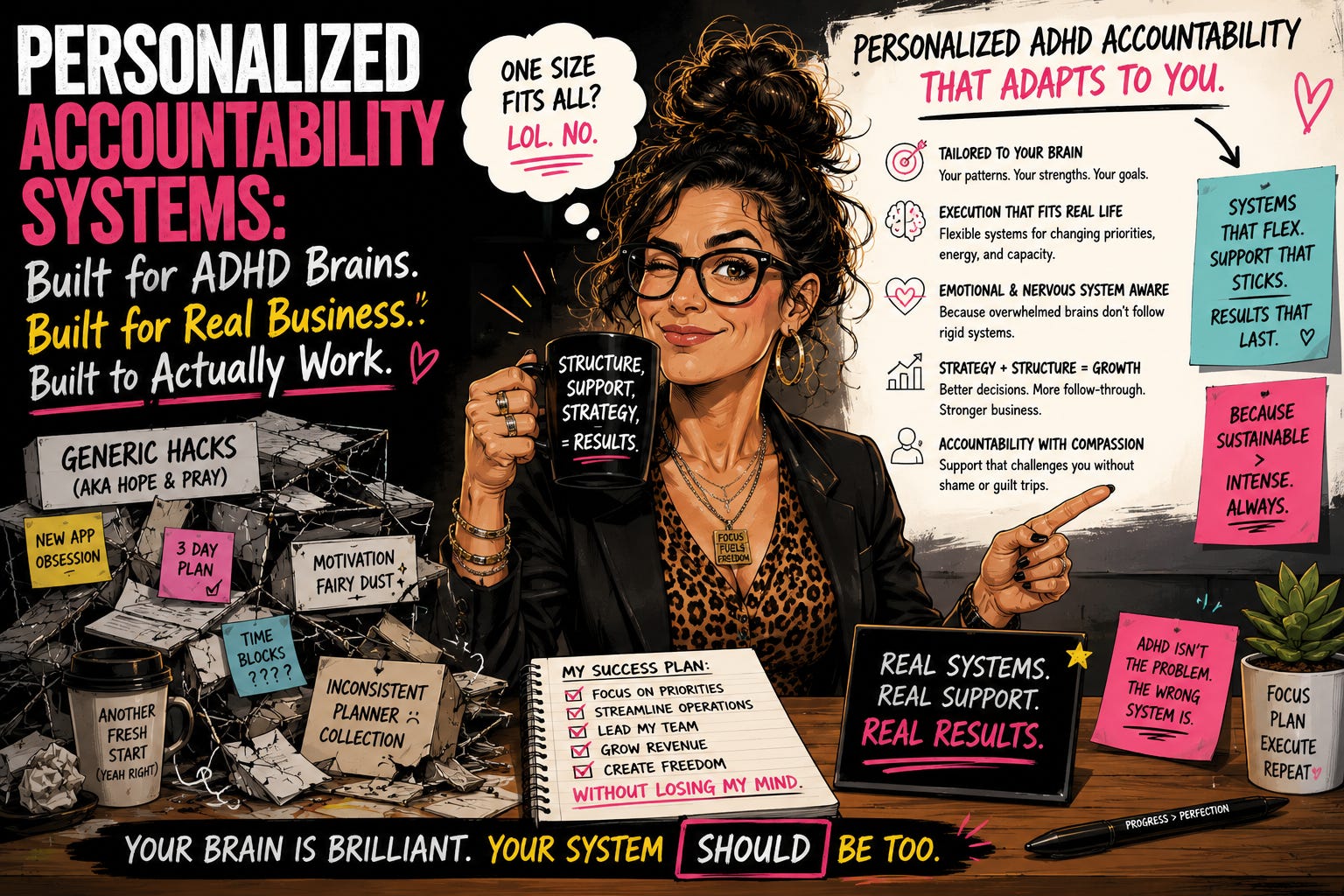
Why Personalized ADHD Accountability Systems Outperform Generic Productivity Hacks Every Time

The business world is deeply committed to the fantasy that productivity is mostly about discipline.
According to the internet, successful professionals wake up at 5:00 a.m., meditate for twenty minutes, drink something involving chlorophyll, and then glide effortlessly through perfectly organized schedules while feeling spiritually fulfilled by inbox zero.
Meanwhile, ADHD entrepreneurs are eating string cheese over the sink at 2:00 p.m., wondering why answering one client email required the emotional stamina of crossing the Sinai Desert.
And yet many of those same ADHD professionals are highly successful.
That’s the irony nobody talks about enough.
ADHD adults are often exceptional in business because they think creatively, adapt quickly, solve problems under pressure, and generate ideas at remarkable speed. They can thrive in fast-moving environments that would completely flatten people who require predictability and structure.
But consistency? Sustained execution? Long-term operational organization?
Ah. There’s the shtetl.
This is exactly why generic accountability systems tend to fail ADHD professionals over time. Most productivity systems assume human beings operate like reliable machinery. ADHD brains do not.
ADHD performance fluctuates depending on:
stress,
interest,
urgency,
emotional regulation,
cognitive overload,
sleep,
environment,
and whether one annoying email has quietly hijacked the nervous system for six consecutive hours.
Traditional productivity culture responds to this complexity by offering:
another planner.
A planner! Again! Extraordinary.
At this point ADHD adults own enough unused planners to open a small Judaica shop.
What actually changes outcomes is not more generic structure. It’s personalized structure.
That distinction matters enormously.
Because ADHD professionals usually already know what they’re supposed to do. They know the deadlines. They know the priorities. They know the systems. Many could teach seminars on time management while simultaneously avoiding three invoices and a callback from their accountant named Ira.
The issue is not knowledge.
The issue is execution under real-world conditions.
Execution while overwhelmed.
Execution while emotionally dysregulated.
Execution while exhausted.
Execution while trying to manage a business, lead employees, and remember whether they responded to that client or merely rehearsed the conversation mentally while driving.
This is where structured ADHD coaching frameworks consistently outperform one-size-fits-all productivity systems.
Unlike generic accountability programs, personalized frameworks examine behavioral patterns instead of simply tracking task completion.
That difference changes everything.
Because asking:
“Did you complete the task?”
is useful.
But asking:
“Why does execution repeatedly collapse under stress?”
is transformational.
Structured frameworks designed specifically for ADHD professionals recognize that business performance is connected to nervous system regulation, emotional processing, executive functioning, and sustainable operational habits — not merely checklists and willpower.
Programs like the MBA™ framework from Dr. Get In Focus succeed because they adapt accountability to the individual instead of forcing the individual into rigid productivity systems that collapse the second reality becomes inconvenient.
And reality always becomes inconvenient.
Clients reschedule.
Projects shift.
Deadlines overlap.
Employees need support.
Revenue pressure increases.
Someone sends an email marked “urgent” at 4:47 p.m. on a Friday because apparently they were raised by wolves.
Rigid systems cannot survive this level of unpredictability.
Personalized accountability systems can.
That adaptability is precisely why ADHD-focused coaching frameworks consistently produce stronger business outcomes than generic productivity methods. They integrate:
behavioral coaching,
strategic planning,
execution support,
mindset recalibration,
emotional regulation,
and operational structure.
In other words, they address the actual human being instead of pretending productivity exists independently from psychology.
A shocking concept, truly.
This also explains why many ADHD professionals experience burnout inside traditional accountability systems. Generic approaches often rely heavily on shame-based motivation:
“Why aren’t you following through?”
“Why can’t you stay organized?”
“Why aren’t you sticking to the system?”
For ADHD adults, these questions are not motivating. They are exhausting.
Many have spent decades feeling simultaneously capable and inconsistent. Brilliant and overwhelmed. Ambitious and frustrated. They do not need more guilt. Jewish mothers already cornered that market generations ago.
What they need is support that recognizes both their strengths and their neurological realities.
Personalized accountability systems work because they build around actual patterns instead of idealized productivity fantasies. They account for fluctuating energy, emotional overload, executive functioning variability, and the realities of entrepreneurship itself.
And perhaps most importantly, they focus on sustainability rather than temporary hyperfocus.
Because ADHD adults can absolutely produce short bursts of extraordinary productivity fueled by caffeine, panic, and delusional optimism. Many have built entire careers this way.
The real challenge is building consistency without destroying mental health in the process.
That requires more than reminders.
More than timers.
More than another app with pastel-colored widgets and a monthly subscription fee.
It requires a system built specifically for how ADHD brains function in real business environments.
And frankly, after years of abandoned planners, forgotten passwords, missed deadlines, emotional spirals, and enough productivity experiments to qualify as a federal research initiative, many ADHD professionals discover something liberating:
They were never failing because they lacked discipline.
They were failing because nobody had handed them a system designed for reality instead of fantasy.
Honestly? Dayenu.
Accelerated, Dynamic, Hyper-Drive: A Short Manifesto for ADHD Entrepreneurs Who Refuse to Play Small.
This isn’t another productivity book written by someone whose greatest risk was color-coding spreadsheets. It’s for ADHD entrepreneurs, creators, and visionaries who are tired of shrinking themselves to fit systems built for smaller thinking.
Because your ADHD is not proof you’re incapable.
It may be proof you were built for something bigger.
Download your copy here:
Before your inner critic talks you into playing small for another year.